Home>News
Hongqiao Hub ushers in EVs rental services
Launched in 2015 by Shanghai International Auto City Group Ltd, or SIAC, EvCard is China's first EV rental service, deploying 3,000 stations and about 6,000 cars in Shanghai.
It also serves a further 23 Chinese cities.
The rate is 15 yuan ($2.2) for the first 30 minutes, with each minute a further 0.6 yuan in town, and 0.5 yuan out of town. The daily rent ceiling is 219 yuan for choices such as the Roewe e50 or Chery EQ. A BMW i3, a more upscale car, costs more.
Last month, the State Council announced plans to develop the sharing economy, amid efforts to boost innovation and entrepreneurship.
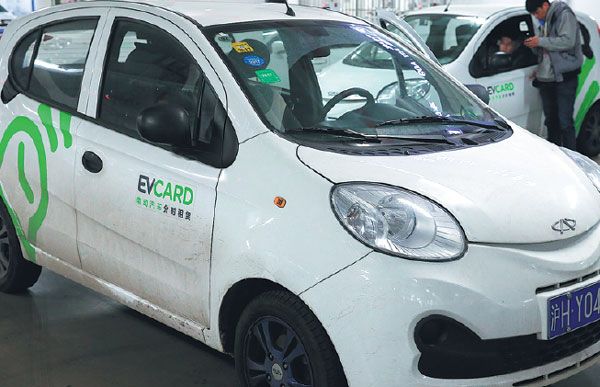
Customers go through the booking process of renting an EvCard electric car at the Shanghai Hongqiao Railway Station hub. Pei Xin / Xinhua
Rong Wenwei, chair of the SIAC board, said that when the idea of EV rental first came to China, a number of large vehicle rental firms were interested but dragged their feet due to uncertainty over profitability.
State-funded SIAC, though, had no such hesitation.
"In such a metropolis, each step to make the streets less choked and the air less polluted is worth taking," said Zhu Jing, who is in charge of the EvCard business division. The effort is paying off. EvCard now leads the world's green car rental service with the most EVs, self-service rental spots and membership clients, and is set to make a profit in Shanghai next year.
By 2020, it plans to build a fleet of more than 300,000 cars to serve in 100 Chinese cities. "It isn't impossible that cities like Shanghai will see car numbers drop," Zhu said.
His words were echoed by Zhu Xichan, a professor at the School of Automotive Studies at Tongji University in Shanghai.
"The car has turned from a luxury to a household item in China. Limited resources and roads make car sharing the most convenient transport solution," he said.
"The idea of sharing, plus new energy vehicles, may well be an answer to private transportation while the number of cars can also be reduced," Zhu added.
Statistics are encouraging. DriveNow, a car sharing service launched in 2011 in Germany, has pulled down private car use in Munich by 25 percent in the past few years, according to German reports.