
Cars in China
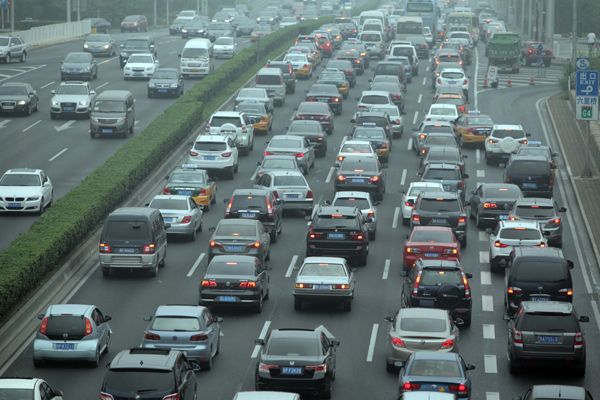 |
| A road in Beijing during rush hours. |
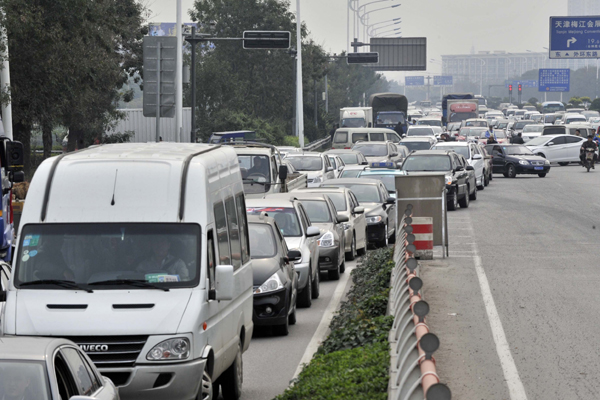 |
| Busy traffic in Tianjin. |
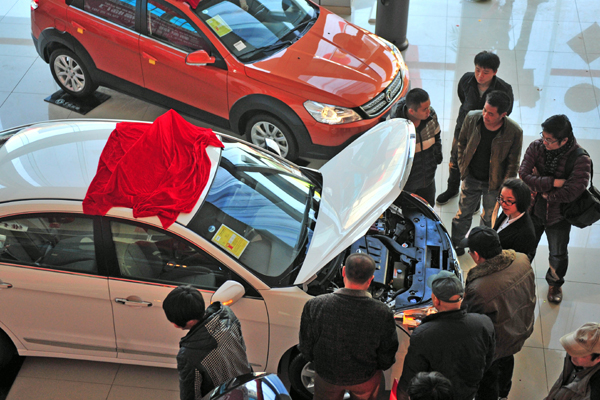 |
| Consumers consult a sales in a 4S Shop. |
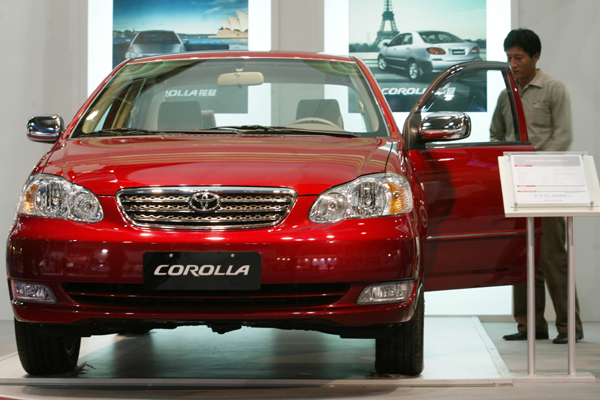 |
| Toyota is a popular among cabbies. |
My first trip to China was 1986. At that time, there were no privately owned cars, all vehicles were registered and owned by companies and there were only 5,000 passengers cars manufactured in China. In 1985, it would have been hard for you to see any luxury cars, a Mercedes was an exception, and most cars were Volkswagen, Santana and Audi's. Just 30 years later, and China is now the world's largest car manufacturer, making over 20 million automobiles each year, USA is number 2 producing 15 million units annually.
Of course being number one has also produced a formidable traffic problem. From no private cars in 1986, there are now over 200 million privately owned cars in China, about 6 million in Beijing and almost 3 million in Tianjin. The numbers continue to grow as young couples strive to own an apartment, buy a car and have a baby, not necessarily in that order. As for luxury cars, there is a significant segment of rich that tend to show off their wealth by driving the most expensive cars available. When you pass by a five star hotel or restaurant you will see more Bentley's, Rolls Royce's, sports cars such as Ferrari's or Lamborghini's than you will see in North America.
This love of cars and huge growth has necessitated an implementation of restrictions to try and limit the numbers on the overcrowded roadways. In Tianjin and Beijing, a license plate lottery has been in place, in order to obtain a new car plate, you must submit an application into a pool and only a limited number of new plates are available every month. In Shanghai, they have implemented a system of monthly auctions for new plates, one now costs over 80,000 RMB. Also according to the last number of the plate, cars are not allowed on the roads one day a week from Monday to Friday from 7am to 8pm depending upon the daily weekday restriction. These restrictions are posted widely and shown in the local papers or you can call operator assistance at 114 and they will confirm if your number is allowed on the road.
Don’t forget that these restrictions apply to other cities, so if you are driving to Beijing, your Tianjin plate is considered a foreign plate and are restricted during rush hour periods in addition to the weekly restriction. It is said that China invented bureaucracy and if you look at the licensing system, you will agree. Each province has its designated license identification, for example, Tianjin is the initial character Jin, Beijing is Jing and the neighboring Hebei province is Ji. This is further segmented when there are several other cities in the province such as Shijiazhuang, which is the capital and largest city in Hebei. There car plates are Ji A. This may also be a good place to remind you that Jin E is the official plate for Tianjin taxis otherwise they are illegal or "Black Taxis". If you see a plate with the character Qiong you may wonder how it got to Tianjin, because this stands for Hainan Island.
Other plates to note are white plates, which represent a branch of the military forces. These plates usually have the run of the road and are not restricted by the police. A black plate represents a foreign company vehicle. These are getting fewer as they have stopped issuing this type of plate a number of years ago and those you see are older plates. They were originally issued to provide foreign owned cars with some privileged benefits but these have long ceased. Diplomatic plates are also have their specific format, they are black with the red character Shi which stands for Embassy and the first 3 numbers designate the country. For example 123 is Canada and 224 is United States, and if the following 3 numbers are 001, it is the Ambassador's car.
Assuming that you are able to obtain a license plate and you have considered all the economic reasons why purchasing a vehicle is the worst investment one can make, not just in China, but especially in China. Once you purchase a car, the asset immediately depreciates and never appreciates over time. If you calculate the total costs, in terms of fuel, maintenance, insurance, parking and highway tolls etc. It would make better economic sense to take public transportation, a taxi or rent a vehicle when required. However, in this age, most of us have grown up in a culture of owning a car, being able to control our own destiny and being able to drive anywhere and anytime that we want. This is especially true in the West, where as a teenager, having your own vehicle is a way of life and something all is accustomed to.
In China, owning a car is a status symbol. You are judged by having your own car and the type of car you drive. The next level up is when you not only own the car, but can afford to hire a driver to do the driving. If not for recent developments of GPS (Geographic Positional Systems), driving in China for non-Chinese speakers would be virtually impossible. This has now all changed and these devices are quite accurate, even in an environment of constant new roadway additions.
So you have decided to buy a car in China, there are still a few things to be remembered. If you decide to buy an imported car, expect to pay as much a double or triple the manufacturers’ listed price back home. This is changing as the Chinese authorities have declared that this is unfair for the Chinese market and import duties are expected to drop. However with over 20 different Chinese manufacturers of local brands, it will likely be some time before the import duties are lowered significantly which presently serves to protect the domestic manufacturers.
Another purchasing option is to buy second hand or also known as a pre-owned vehicle. This market is not as developed as in the West, where used car lots are as numerous as new car lots and in fact some sell new cars and used cars in the same facility. In China, this is growing but slowly. Chinese still have an aversion to buying something that is previously owned by a stranger. There is a culture of "losing face" (in Chinese known as: Mei MianZi) and the perception of not being able to afford to buy new. Some Chinese new car dealers will have access to used cars when clients trade in their old vehicle and buy a new model. But unless you have an exceptional relationship with the dealer, these deals will be gobbled up by friends and relatives.
Owning an older vehicle also comes with the added burden of the annual vehicle inspection for cars that are over 3 years old. This is a time consuming exercise that means you need to take at least half a day to run your car through a government facility. The alternative is to pay a "car club" to do this for you and if you pay the extra fee, they will guarantee that the vehicle will pass the inspection. This process is also another way that the government ensures that everyone pays for their traffic infractions. One of the first checks made during the inspection process is a review of outstanding traffic tickets, for moving violations, parking and highway infractions. There are a series of infractions ranging from point deductions and monetary fines. Going over 12 point's means your driver's license will be suspended. You can have it reinstated by taking a driver re-education course. You can also avoid the points by allowing someone else to assume the infraction. This is a thriving business at all Police Traffic Offices, individuals will hang out at the front door selling the service to "use" their driver's license for your infraction, usually at the price of 100 RMB per point.
You will need to buy insurance for your vehicle, take a good Chinese friend who is a driver and understands the policies to help explain the options of the policies. There are minimum coverage requirements. The premium will depend upon the replacement value of your vehicle, with the higher the value meaning the more costly the premium.
Are you sure you really want to drive in China? Now that you have cleared all the hurdles to buy a car, you need to ask the question, will you be able to cope with driving conditions here. Due to the extreme high number of vehicles, driving is China is not anything like driving in the West, even in downtown Manhattan. Do not misunderstand, the drivers in China are not bad drivers, in fact, they are probably more skilled at driving than any Western driver. In order to manipulate in the endless sea of traffic, the drivers here are much more aggressive. Tailgating and constant changing of lanes is a must if you want to make any progress during rush hour traffic.
In the West, you will likely find driving to be leisurely and a time to relax. Perhaps even putting on cruise control and listening to some of your favorite music. Not so in China, you will likely never use your cruise control and your favorite "music" is likely that of your GPS instructions. Some of the new vehicles have a safety feature of automatic braking if you are too close to another vehicle. This feature is useless though because traffic here dictates tailgating or else other drivers will cut you off. Driving in China requires much more attention. You need to be aware of traffic patterns developing ahead in order to anticipate your next move. Driving for an hour here is very draining of your energy and nerves. You will find that a normal 3 hour drive in the country back home will be torture here and require a similar recovery time. Remember this is even after the implementation of limiting new license plate registrations and a 20% reduction in the cars on the road by means of weekly driving restrictions. The only way to really avoid all this nonsense is if you are fortunate enough to hire a driver to handle all the driving. Then you can actually sit back and listen to your music or play with your smartphone.
All things considered, cars are still selling in China. Major cities like Beijing, Tianjin, Shanghai and Shenzhen all represent huge car markets. We will now compare the differences in the car buying process in China versus overseas. Let’s use Tianjin as a sample market. What factors into a Chinese person choosing a car goes beyond price, and many times will involve, as mentioned above, what is "socially acceptable". A car should not just be reliable, a good value, or easy to maintain. It should for, many Chinese, be a means to let others know they have the financial prowess to obtain such a car. Putting aside the crazy expensive cars, in general, Audi's are very socially acceptable and sell quite well in Tianjin. Why? One major reason is that many government leaders ride in Audi's, most always black in color. Therefore, a business man pulling up in his black Audi, even if he has nothing to do with the government, may get to bask in the glory of "government official" like treatment.
Another brand which sells well in Tianjin is Toyota. However the surprising thing is who is buying those Toyota's. It isn't the average family. This is in stark contrast to the States where Toyota is a very popular car brand, especially among budget conscious, and quality conscious families. The Toyota Corolla, Camry, Prius, RAV4, and other Toyota models can be seen pretty much everywhere around town in America. Not so in Tianjin. Some of the models are rarely, if ever, seen here. So who is buying all the Toyota's? One major consumer is cab drivers. Tianjin has a huge Chinese-Japanese Joint-Venture Toyota plant. This means that certain models of Toyota cars are widely available, and sold at a price that is less expensive than an imported Toyota. Add to this Toyota's reputation for being easy to maintain and highly reliable, this makes it a top pick among cab drivers.
Ironically, the way Tianjin cab drivers choose a car, is much closer to the way the average western may choose a car. Things like, overall value, durability, maintenance fees, and long-term cost of ownership are all things most expats will have high on their list of things to consider when buying a car be it in China or back home. Since cab drivers are less concerned about "face" and whether their car makes other people think they are "cool" and more concerned about practicality, then likewise the Toyota brand represents a solid choice. Cabbies aside though, Toyota's are not hugely popular with Tianjiner's.
Volkswagen is an interesting brand in terms of who buys it here in Tianjin. First, VW makes the list of possible cab choices for taxi drivers. The types of cars which are allowed as cabs are limited. Cabbies can't just pick any car they want. Albeit VW is typically known to be studier than Toyota in terms of overall car construction, this comes at a price. One, the initial price of a VW is usually higher than a Toyota. Second, fuel efficiency seems to be lower. Thus cost conscious Tianjin cab drivers in most cases choose Toyota over VW. The number of Toyota cabs in Tianjin far outnumbers that of VW cabs. However, it looks like VW was smart and hasn't put all their car selling eggs in one basket. In addition to being available as a cab choice, VW has also made it on the list of cars that some government agencies are using. For example some Police cars in Tianjin could be a VW. Likewise some government leaders have been known to ride in VW's, again like the Audi's, black in color. With VW being "good enough" for the government, so too a number of company bosses seem to feel comfortable making a black VW their choice of car. In this respect the VW brand and what it represents in Tianjin is way different than in the United States. In the States VW is typically a "family" brand. VW would be thought of as a solid choice for the middle class family looking for a great balance between quality and price. Only in recent years has VW been producing more and more luxury level cars, trying to effectively expand its market share beyond the family.
Not only do car brands and what they represent in Tianjin vary greatly when compared with overseas, so too do the models. Not every type of model car commonly available elsewhere will be easily bought in Tianjin. A fascinating phenomenon in this respect is the "old new" car. What's this? Expats may have seen an older model car driving around town that looks like brand new. At first, one might think the owner really knows how to keep up their car. Overseas, this is typically the case if an older style car is still in great condition after years of driving. Not necessarily so in Tianjin. How so? Older year body styles are often still available for purchase brand new! That's right, imagine buying a 2005 model car in 2015, and it isn't used, it is new. This type of situation exists in Tianjin. It actually is a great option. Especially for expats who often aren't buying a car for "face" but rather for the practicality, choosing a brand new car with the body style of yesteryears can save big money. It's like getting the best of both worlds, a cheaper car like buying used, but new in terms of quality.
So we've covered car culture in China, what sells well in China, what is the difference between China buyers and overseas buyers. Next on the list is alternative energy. Car registration and daily driving restrictions in China are sited as necessary for two reasons: to reduce traffic and to reduce pollution. In addition to reducing the rate at which new cars hit the road, or even trying to control the number of cars on the road, there is another option when it comes to easing car related pollution. That is alternative energy vehicles. One of the most popular examples of this overseas is the Toyota Prius. The Prius electric powered car isn't just about cleaner energy, but it has even become a bit of its own sub-culture. Drivers of a Prius tend to "represent" something, an overall lifestyle of going green not just driving a battery powered car to save on gas. What about non-gas automobiles in Tianjin?
For expats interested in Chinese manufactured electric cars they can consider Lifan. Lifan was founded in Chonqing and has made cars for several decades. Currently they have a car dealership located in Tianjin's Beichen district. Side note, as it relates to linguistics, for some odd reason car dealerships are known as "4S Shops" in Chinese. The number four is said in Chinese "si", the S is said in English as simply "S", and then "dian". So it is an odd Chinese, English, Chinese "word", which means "car dealership". Simply add the brand of the car on the front when asking or searching for info online. For example in this case Lifan Car Dealership would be in Chinese: Lifan 4S Shop.
Chinese class aside, back to car talk. So Lifan has two electric car models available. One is a typical four door passenger car, the Lifan 630. The sales price is around 140,000 RMB. Another electric option is a mini-van, which oddly enough in Chinese is known as a "Bread Van". This is sold for around 50,000 RMB. Now the beauty of these electric cars is the availability. Unlike their gas-powered competitors, currently in Tianjin electric cars can be purchased at any time. There is no need to either play the "registration lottery", or pay the whopping fee associated with the "registration auction". Of course, every coin has its flip side. In this case, it is re-charging.
Re-charging electric cars is no small issue. According to the Lifan sales associate there are about 50 re-charge stations around town. However, a recharge of course comes at a cost, and takes time! Perhaps somewhere around 1 hour! Just when you thought getting gas took too long, imagine waiting around for an hour just to charge up your car! The other re-charging option doesn't get much better. One could find a friend and dismount the battery. Then take it inside and charge it for around 6 hours. Depending on how often one drives, this process could become very time and effort preventive! Imagine needing to find a friend every time you need to charge up! Thus, the good of electric cars is, no waiting for a license plate, plus no foul emissions. The bad is, charging up that battery becomes a real pain!
Well, as with everything else in life, there are always pros and cons, and owning a car in Tianjin is no different. Despite the challenges, the numbers don't lie. Cars are still big business in China. Although America may be the "home" of the automobile as it relates to culture. China is claiming its spot as the largest car market in the world. Overcrowded city streets in Beijing, Tianjin, Shanghai, and Shenzhen make this point painfully clear. To try and put a band-aid on the wound, the Central government has placed limits on the number of new registrations granted in many of the major cities, Tianjin included. Add to this, driving restrictions based on license plate numbers. Add to this the intense driving conditions, where roads are shared between cars, trucks, bikes, mopeds, pedestrians, and anything else that can move. When all of these factors are taken into consideration, taking that cruise around town may not be so relaxing after all. Of course there is the option of going green and buying an electric car. However for men with testosterone the idea of stamping down on the pedal of your "go-cart" may not seem appealing at all, let alone when issues like re-charging are considered. When it comes to cars in China, perhaps the best advice can be found in the simple yet time-tested wisdom of: "buyer beware".



Copyright ©
Tianjin Municipal Government. All rights reserved. Presented by China Daily.
京ICP备13028878号-35