AI enterprises show strength in anti-virus fight
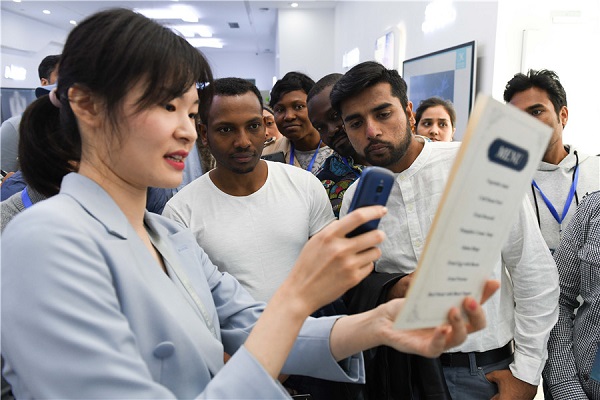
An iFlytek employee shows a group of foreign students around the company's facility in Hefei, capital of Anhui province, on Oct 18. [Photo/Xinhua]
"Hi, this is from the epidemic prevention headquarters, are you in Wuhan?"
"How many people are in your family, and do you have a body temperature above 37.3 C?"
An AI voice assistant developed by Anhui-based AI company iFlytek is automatically calling residents to inquire about their health and determine whether they are likely to be infected with COVID-19.
The assistant has been widely used by health service centers in many communities throughout Chinese provinces such as Anhui, Beijing, and Zhejiang as part of epidemic prevention and control efforts.
Liu Qingfeng, chief of iFlytek, said that "Since the outbreak began, we have seen new growth points in revenue by adding urgently-needed services such as smart medical calls and online purchases of masks."
Online teaching solutions developed by iFlytek have served more than 1,500 schools in 19 provinces since the beginning of the outbreak, according to Ren Pingping, vice president of the education department of iFlytek.
Companies similar to iFlytek that operate in China Speech Valley, the first national industrial center for AI, have tapped into cutting-edge technologies in the battle against COVID-19, which has helped strengthen anti-virus efforts.
Qi Dongfeng, president of the operating unit of China Speech Valley, said that during the epidemic consumption habits changed, which will accelerate the development of a new economy revolving around the AI industry".
Smart wearable device maker Huami resumed operations in China Speech Valley on Feb 10. "We are optimistic about the company's development in 2020," said Hunag Wang, the company's CEO. "Smart wearables have bright prospects in the face of the ongoing health crisis."
Huami, which has long been committed to using technology to improve people's health, is now busy providing products to help people exercise at home.
In order to help enterprises cope with the impact of the epidemic, the Anhui government has rolled out a series of measures to reduce rents and taxes, provide financial support, and help enterprises explore and cultivate new business opportunities.
An online marketing platform created by China Speech Valley has played an important role in helping small and medium-sized enterprises sell AI products amid the epidemic.
"When offline retail stores closed due to the epidemic, our products were still available to customers thanks to the online platform," said Feng Haihong, founder of Anhui MiMouse Technology Company.
Employees for the platform stock the enterprises products and deliver them directly to customers. Since the beginning of the outbreak, the platform has carried out 1.3 million yuan ($185,929.9) worth of orders.
"In addition to support from the government, more than 800 enterprises in China Speech Valley are working together to leverage their strengths," said Qi.
"For example, an intelligence development platform is providing free computing support for scientific research institutes; iFlytek is providing free intelligent conference systems for telecommuting; and an internet company is building a vehicle support platform to ensure a safe commute for employees of enterprises who have resumed work."
Hu Gongjie, vice president of the Anhui Economic Research Institute, said that the strong vitality shown by the AI industry of China Speech Valley, benefits from the valley's accumulated technological strength and also shows that enterprises have a strong ability to make the best of difficult situations.
Qi said that "We will seize new opportunities to enhance R&D capabilities and expand applications of technologies. China Speech Valley is aiming to generate more than 100 billion yuan in operating income in 2020."
- |
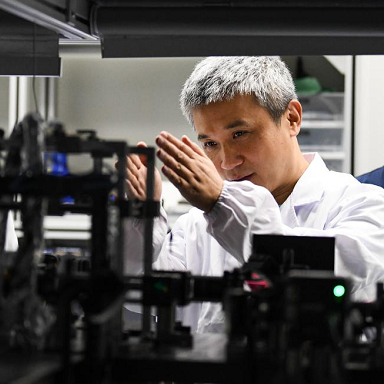
Peng began to participate in the research of quantum science and technology in 2003. Since then, he has taken part in...
- |

Cao is not only a successful entrepreneur but also an advocate for the development of the national clean energy indus...