Quantum scientists receive Micius prize in Hefei
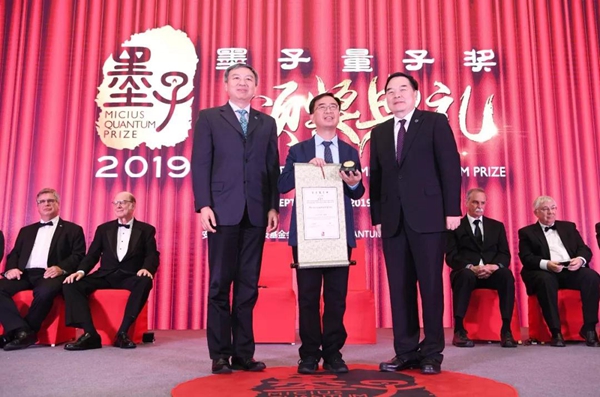
Pan Jianwei (center), chief scientist for the world's first quantum satellite launched by China – Micius -- is awarded the Micius Quantum Prize at an awards ceremony in Hefei on Sept 18. [Photo from WeChat account hefeigaoxinfabu]
The awards ceremony for laureates of the 2018 and 2019 Micius Quantum Prize was held in Hefei, capital of East China's Anhui province, on Sept 18.
Each of the 12 laureates got 1 million yuan ($140,663) and a gold medal as reward for their outstanding contributions to the fields of quantum science and technology.
Funded by Anhui companies, the Micius Quantum Prize, named after the world's first quantum satellite launched by China – Micius -- was set up in 2018 to promote the emerging quantum technologies.
Anhui is home to the county's leading quantum research team, technology university, quantum companies and institutions. It is now building the national laboratory for quantum information science and technology.
Officials said the province hopes to see more breakthroughs in quantum-related fields and encourage innovation in the development of quantum information technologies, by awarding international quantum scientists who have achieved great accomplishments.
Pan Jianwei, chief scientist for Micius, commended the establishment of Micius at the awards ceremony.
He looked back on his team's quantum research over the years, saying the national support, especially support from Anhui, meant a lot for their later success.
The prize includes two categories -- theory and experimentation. The 2018 Micius Quantum Prizes were given to six scientists in the field of quantum computation, while the 2019 Micius Quantum Prizes were given to six scientists in the field of quantum communications.
The 2018 laureates for theory are Juan Ignacio Cirac, David Deutsch, Peter Shor and Peter Zoller -- for their seminal theoretical work on quantum algorithms and physical architectures of quantum computers and simulators.
The experimental category prizes went to Rainer Blatt and David Wineland, for pioneering experiments that demonstrated the fundamental elements of quantum computing with trapped ions.
The 2019 prizes were awarded to Charles Bennett, Gilles Brassard, Artur Ekert and Stephen Wiesner in the theory category -- for their work on quantum cryptography -- and the experimental prizes went to Pan Jianwei and Anton Zeilinger, for their groundbreaking experiments that enabled practically secure and large-scale quantum communications.
Following evaluations by the judges consisting of local and international academicians and professors, the results were announced in April.
Officials said they captured a lot of attention from worldwide academic institutions and the media.
- |
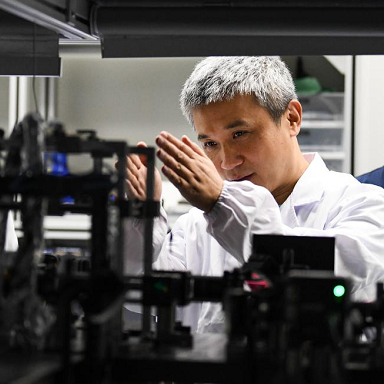
Peng began to participate in the research of quantum science and technology in 2003. Since then, he has taken part in...
- |

Cao is not only a successful entrepreneur but also an advocate for the development of the national clean energy indus...