
Qingchuan's specialty products shine at promotion event in Hangzhou
Qingchuan county in Guangyuan, Sichuan province impressed attendees with its premium agricultural and ecological products at the Guangyuan Food and Beverage Industry Investment Promotion Conference held in Hangzhou, Zhejiang province on May 28.
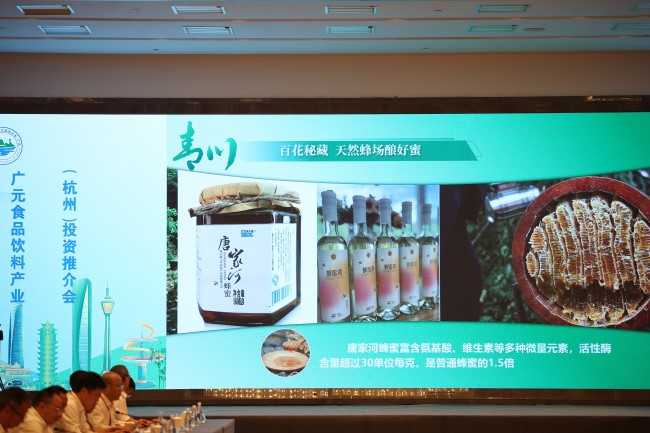
The honey produced in Qingchuan cunty, Guangyuan, Sichuan province is highlighted as a star product at the event. [Photo provided by Guangyuan city]
Blessed with pristine mountains, abundant water, and a favorable climate with distinct seasons, the county spotlighted five key categories: tea, edible mushrooms, authentic medicinal herbs, ecological honey, and high-quality water resources.
Qingchuan currently has over 20,000 hectares of tea plantations. Qifo Tribute Tea stands out with a history spanning over 3,000 years. It was once favored by Empress Wu Zetian (690-705) of the Tang dynasty. The brand's value has reached 2.48 billion yuan ($345.19 million), as it has earned national recognition, including the "Protected Eco-origin Product by China" designation and the status of "China Well-Known Trademark".
The county's edible mushroom cultivation dates back to the Tang Dynasty. Traditional ecological techniques—such as drilling oak logs and relying on rain for mushroom growth—are still practiced today.
Qingchuan is known as the "hometown of edible mushrooms in China", with an annual output exceeding 16,000 tons. The local black fungus is rich in iron and calcium, bamboo fungus is protein-rich, and morel mushrooms offer 18 essential amino acids and eight vitamins, making them highly nutritious.
Boasting a forest coverage rate of 74.01 percent and an elevation range of up to 3,400 meters, Qingchuan's diverse microclimates support the cultivation of various authentic Chinese medicinal herbs. The Gastrodia, in particular, contains 0.62 percent gastrodin—more than double the national pharmacopoeia standard—making it a premium food-medicine dual-use product.
The region is also home to more than 100 nectar-producing plant species, including more than 50 high-quality varieties. Beekeepers maintain 101,000 colonies of Chinese honeybees. The Tangjiahe Honey is rich in amino acids, vitamins, and trace elements, and it has been included in the national list of premium agricultural products.
Qingchuan is one of the most water-abundant areas in northern Sichuan, with total water resources reaching 2.24 billion cubic meters. Water quality of the Bailong River and Qingzhu River consistently reached Level I standard, the top level in China. Local springs are also rich in beneficial minerals like strontium and metasilicic acid.
With its unique natural endowments, robust transportation network, and comprehensive industrial support, Qingchuan offers promising opportunities for investment in the food and beverage sector.
Li Fangfu, Party secretary of the county, invited entrepreneurs to consider Qingchuan for investment, especially in deep processing of specialty agricultural products and integrated water resource utilization. He pledged full-cycle, all-round services for businesses investing in the region.