
Jianmen tea thrives along ancient pass
The Jianmen Pass Tea Plantation in Guangyuan, Sichuan province, perched over 1,000 meters above sea level, is nestled in a pristine environment far from and industrial pollution. Here, tea trees thrive in the pure mountain air, developing a unique aroma and flavor.
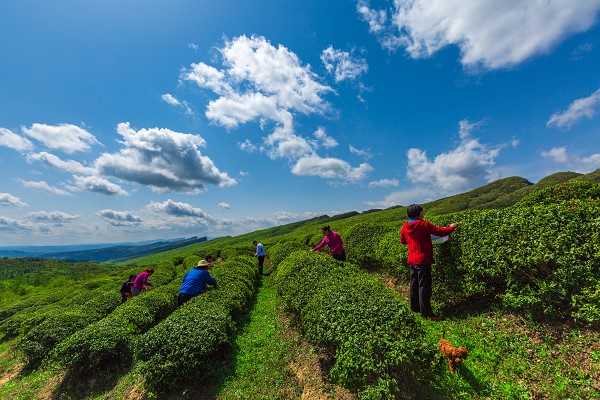
Local farmers pick up tea leaves in the Jianmen Pass Tea Plantation in Guangyuan, Sichuan province. [Photo provided to cngy.gov.cn]
Jianmen Pass is also steeped in history, as it lies along the ancient Tea-Horse Road, a route that has long been a conduit for tea culture and trade.
According to The Classic of Tea written by Tang scholar Lu Yu, the purple buds, which appear in young tea shoots due to anthocyanin accumulation, are prized for their quality.
Compared to standard green tea leaves, purple bud tea contains significantly higher anthocyanin levels—ranging from 5 to 10 percent, which is 50 to 100 times more than in ordinary tea leaves. Anthocyanins, as natural water-soluble pigments, offer powerful antioxidant and anti-radiation properties while also protecting against UV damage.
After generations of cultivation and refinement, Jianmen Pass Purple Bud Tea has developed into a stable and distinctive variety.
As spring unfolds, visitors can capture the essence of the season with every sip.