
Qingdao uses tech to invigorate economy
During the 14th Five-Year Plan (2021-25), Qingdao has positioned technological innovation at the heart of its development strategy, using it to cultivate new quality productive forces.
This coastal city in Shandong province has been recognized five times as one of "China's best cities for talent acquisition" and 14 times as "the most attractive Chinese city in the eyes of foreign talent".
Over the past five years, Qingdao has propelled innovation through institutional reforms, introducing a comprehensive set of policies in areas such as industrial innovation, talent aggregation, marine technology, research investment and tech finance.
The city has shifted its focus from expanding industrial scale to enhancing core competitiveness, thereby strengthening its industrial system. Qingdao has concentrated on upgrading and enhancing its advantageous industries, developing emerging industry clusters, strategically planning future industries and boosting marine industries.
It has also accelerated the advancement of several technological demonstration projects, covering such sectors as hydrogen energy, national core mega-screens, perovskite solar cells, and large-scale space-ground integrated information networks, in a bid to enhance its industrial core competitiveness.
Qingdao's achievements in sci-tech innovation over these five years include the development of a high-speed maglev transport system capable of reaching speeds of 600 kilometers per hour, a carbon fiber subway train, a high-speed train reaching 450 km/h, and a 150,000-metric-ton intelligent fisheries aquaculture vessel.
Additionally, the city's intelligent home appliances, rail transit equipment, instruments and meters, and marine engineering equipment have been selected as national-level advanced manufacturing clusters.
Seven industries, including rubber and plastic materials, electric power steel structures, fine and specialty chemicals, and industrial control systems, have been acknowledged as national characteristic industrial clusters for small and medium-sized companies.
Throughout this period, Qingdao has focused on building high-level platforms, advancing the construction of the national major scientific infrastructure — the Zhonghua Thermal Physics Experimental Device — and hosting three national-level innovation centers in high-speed train technology, intelligent home appliances and virtual reality.
Qingdao has deepened its collaboration with the Jingjinji (Beijing-Tianjin-Hebei) National Center of Technology Innovation and promoted the integrated development of the Chinese Academy of Sciences' Qingdao Bioenergy and Bioprocess Technology Institute, the Energy Research Institute of Shandong Academy of Sciences and Qingdao's new energy laboratory.
This initiative has led to cutting-edge technological achievements, including perovskite solar cells and sulfide solid-state batteries.
Enriching the "vegetable basket "of its residents has been another focus. Qingdao has explored new models for deep-sea aquaculture of seafood such as large yellow croaker and developed a new triploid oyster variety.
The city has also introduced more than 40 varieties of vegetable and achieved record yields with new salt-tolerant rice strains, turning these innovations into real benefits and improved well-being for residents.
Over the past five years, Qingdao has accelerated the creation of an internationally competitive technological innovation environment, fostering the reciprocal sharing of innovative technologies.
The city's "circle of innovation friends" is expanding. Centered around national strategies such as the China-SCO (Shanghai Cooperation Organization) Local Economic and Trade Cooperation Demonstration Area, Qingdao has established the China-SCO Sci-Tech Innovation Cooperation Center and the China-Japan-ROK Innovation Cooperation Center.
It has also launched the Shandong-Hong Kong Innovation and Technology Cooperation Center and China-Thailand and China-Saudi Arabia joint labs under the Belt and Road Initiative, alongside hosting major events, such as the SCO Member States Youth Innovation and Entrepreneurship Competition and the Dragon Programme international symposium.
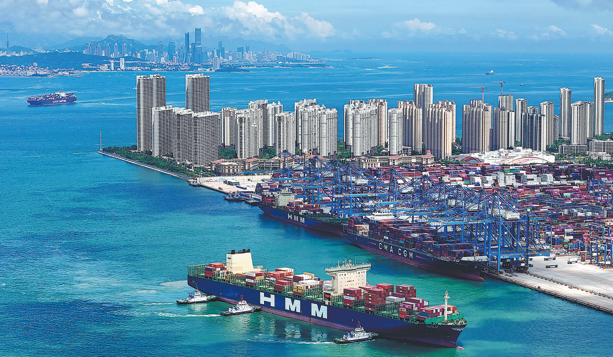
Qingdao Port, operated by Shandong Port Group, is a large foreign trade port and key shipping and logistics hub and serves as a core trade gateway linking Northeast Asia and the globe. CHINA DAILY

Guests from SCO-related countries visit Haier in Qingdao, which is home to the China-SCO Sci-Tech Innovation Cooperation Center. CHINA DAILY


 Play
Play  Play
Play 