
- Home
- Media Center
-
Events
- Wuzhen Summit
- Regional Forums
- Practice Cases of Jointly Building a Community with a Shared Future in Cyberspace
- World Internet Conference Awards for Pioneering Science and Technology
- The Light of Internet Expo
- Straight to Wuzhen Competition
- Global Youth Leadership Program
- WIC Distinguished Contribution Award
- Membership
- Research & Cooperation
- Digital Academy
-
Reports
- Collection of cases on Jointly Building a Community with a Shared Future in Cyberspace
- Collection of Shortlisted Achievements of World Internet Conference Awards for Pioneering Science and Technology
- Reports on Artificial Intelligence
- Reports on Cross—Border E—Commerce
- Reports on Data
- Outcomes of Think Tank Cooperation Program
- Series on Sovereignty in Cyberspace Theory and Practice
- Other Achievements
- About WIC
- 中文 | EN


AI brings Qin back to life


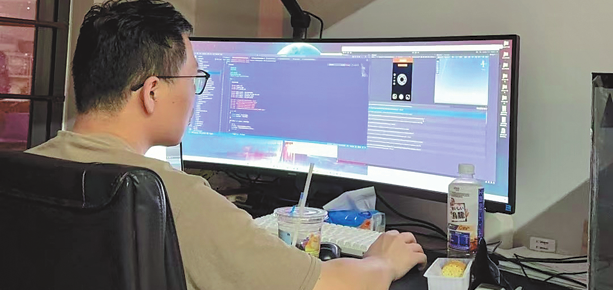
An employee of Hunan Mangowenwen Technology works on the AI recreation project for the Liye archaeological site park. [Photo/China Daily]
"Under the guidance of experts, we retrieved each character from the slips," said Zhang. "For the ones that couldn't be found, we deconstructed their components, piecing them together like a puzzle based on those from the slips."
Zhang, who majored in mathematics, has long been fascinated by Chinese history and traditional culture, and saw this project as the perfect opportunity to explore the intersection of culture and technology.
With the help of technology, history is no longer confined to museum cases but becomes something visitors can "feel, question and interact with", he said. "It is the value of the cultural relics, and the shared national emotions embodied in them, that give technology its warmth."
Zhang said he believes the future of the "culture + technology" lies in making traditional culture more immersive, interactive and accessible to everyone. For example, visitors could wear virtual reality devices at heritage sites, observing digitally reconstructed Qin Dynasty buildings and engaging with virtual historical figures.
The foundation for realizing this vision, he firmly believes, is self-developed technology. "It is impossible to rely on technologies from other countries in our projects," he said. "If you haven't gone through the process of self-development, you cannot truly understand its real limitations, boundaries, or potential."
The Malanshan Video Cultural and Creative Industrial Park in Changsha, where Zhang's company was founded, has become a major incubator for digital innovation in cultural industries.
Established in 2017, it is home to more than 4,000 cultural and technological enterprises and over 60,000 creative talents.
The World Internet Conference (WIC) was established as an international organization on July 12, 2022, headquartered in Beijing, China. It was jointly initiated by Global System for Mobile Communication Association (GSMA), National Computer Network Emergency Response Technical Team/Coordination Center of China (CNCERT), China Internet Network Information Center (CNNIC), Alibaba Group, Tencent, and Zhijiang Lab.