


Hubei's inland shipping industry strives for green, smart development


- Share


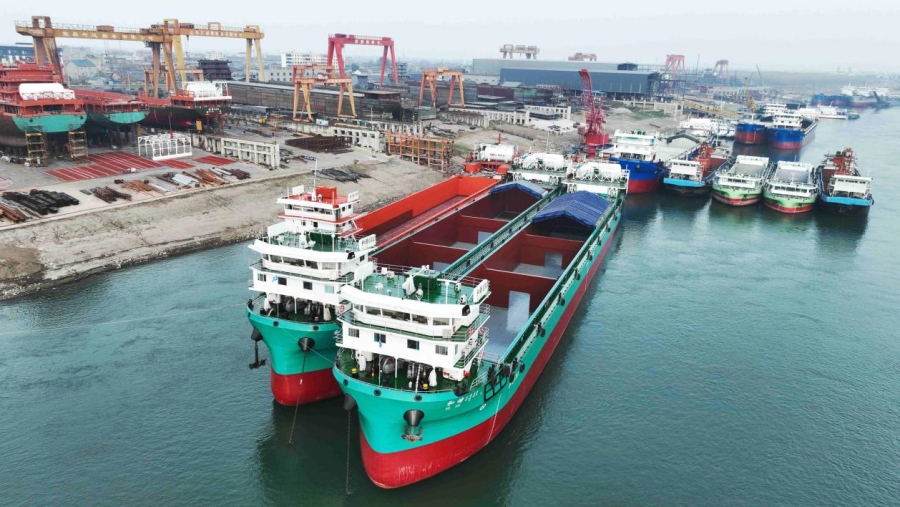
Vessels are built at the Yichang Shipbuilding Industrial Park in Zhijiang, central China's Hubei province. [Photo/Liu Weidong]
At a dedicated dock of shipbuilder China Star Shipping in Yichang, central China's Hubei province, a bulk carrier named Gezhouba, nearly 130 meters long with a maximum deadweight of 13,740 tons, is undergoing outfitting and is scheduled for delivery in March 2026.
"This 10,000-ton-class all-electric bulk carrier integrates breakthroughs in new-energy propulsion with intelligent navigation and control," said Yan Xinping, an academician of the Chinese Academy of Engineering and a professor at Wuhan University of Technology.
According to him, Gezhouba is the first large inland vessel equipped with an intelligent navigation and control system, which enables remote operation, autonomous obstacle avoidance, and automatic berthing and unberthing.
Hubei province leverages its extensive waterways, transportation networks, and industrial expertise to transition inland shipping toward green and intelligent solutions. The province is home to 29 shipbuilding enterprises above designated size, or those with annual main business revenue of 20 million yuan ($2.85 million) or more. Its annual shipbuilding capacity stands at 5.31 million deadweight tons.
At the China State Shipbuilding Corporation (CSSC) 712 Institute in Wuhan, technicians conduct integrated shore-based testing of battery, motor, and control systems -- components that power over half of China's new energy marine propulsion systems.
"This year, we have released a range of second-generation green and intelligent equipment, including high-safety containerized marine power supplies, actively balanced battery packs, and smart ship bridge systems," said Li Mingyong, deputy director of CSSC 712 Institute.
Hubei is working to optimize the supply system of its inland shipping industry by prioritizing greener vessel propulsion, making breakthroughs in autonomous navigation technologies, accelerating the development of standardized ship models tailored to ports, waterways, and cargo types, strengthening high-end shipbuilding capabilities, and actively expanding into international markets. Its efforts center on five key directions: green development, intelligence, standardization, high-end development, and internationalization.
A series of demonstration new energy vessels have been launched in the province, including the world's largest-capacity all-electric cruise ship, China's first hydrogen fuel-powered vessel, and the country's first 10,000-ton-class inland bulk carrier powered by a methanol dual-fuel electric propulsion system.
"Behind these achievements is the growing strength of Hubei's collaborative innovation system that integrates enterprises, research institutions, and universities," said Li Jinkun, an official with the Hubei provincial office of science, technology and industry for national defense.
The province has built a high-level innovation ecosystem, which is supported by national key laboratories such as the State Key Laboratory of Maritime Technology and Safety and the Hubei Donghu Laboratory, and joined by Huazhong University of Science and Technology, Wuhan University of Technology, Naval University of Engineering, CSSC 712 Institute and CSSC 719 Institute, as well as the Wuhan branch of the China Classification Society and its Wuhan Rules and Research Institute.
At the Yichang Shipbuilding Industrial Park in Zhijiang, Hubei province, a batch of new energy vessels are under construction. In late November, a 130-type LNG (liquefied natural gas) single-fuel river-sea direct multipurpose vessel was delivered. Benefiting from the Yangtze River shipbuilding supply chain platform, which integrates research and development, design, construction, and finance, the vessel was delivered one month ahead of schedule, with overall costs reduced by 4 percent.
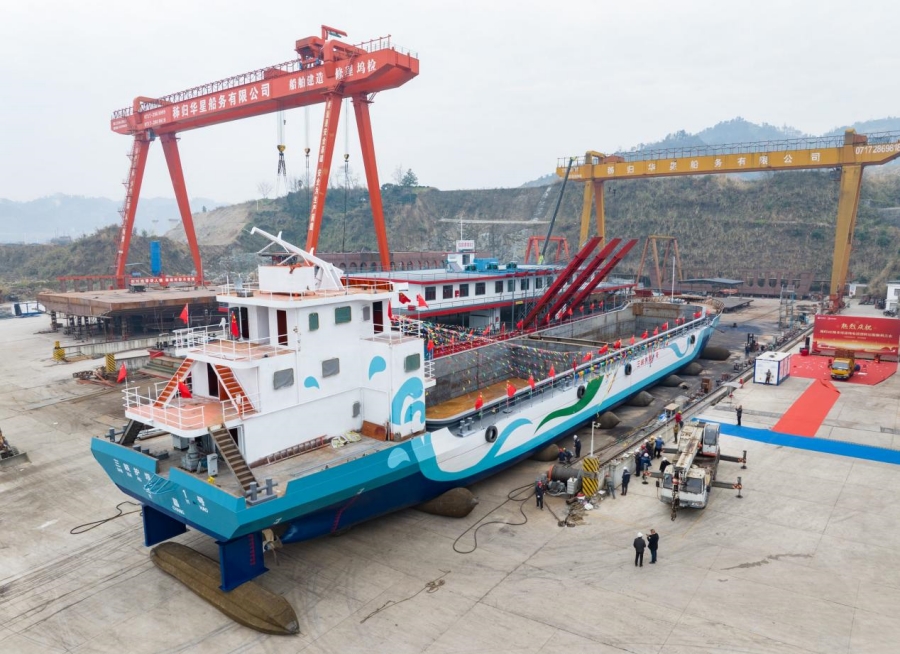
A pure electric debris-collection and transfer vessel is built at the green and intelligent shipbuilding industrial park in Zigui county, Yichang, central China's Hubei province. [Photo/Lei Yong]
Hubei has encouraged financial institutions to develop innovative green credit, financial leasing, and guarantee products. It has also established specialized supply chain platforms to provide companies with one-stop services covering information sharing, logistics and trade, and technological support.
The province has taken the lead in introducing an administrative filing system for the shipbuilding industry and easing market access requirements. At the same time, it has focused on key sectors such as freight transport and cultural tourism to develop representative application scenarios.
By strengthening coordination among the industrial, innovation, talent, capital, and service chains, Hubei continues to improve the ecosystem for its inland shipping industry.
In the first three quarters of 2025, Hubei's shipbuilding industry generated an output value of 72.71 billion yuan, up 17.3 percent year on year. Newly secured ship repair and construction orders totaled 289 vessels, with green and intelligent ships accounting for 75.8 percent of the total.