

Live report: press conference of the 2nd World Internet Conference
The State Council Information Office holds a press conference for the 2nd World Internet Conference at 10 am, Dec 9. Lu Wei, minister of the Cyberspace Administration of China, Ren Xianliang, deputy minister of the Cyberspace Administration of China, and Ge Huijun, member of the Standing Committee of CPC Zhejiang Provincial Committee and director of the publicity department of the CPC Zhejiang Provincial Committee, are invited to introduce the 2nd WIC, which is to be held at Wuzhen, in Zhejiang province, Dec 16-18. They will also answer the questions of journalists from home and abroad.
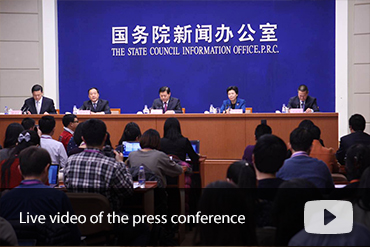
9:56 a.m.
Lu Wei:
Dear friends from the press,
Good morning!
Welcome to the press conference of the Second World Internet Conference. One year ago, I was here to welcome you at the First World Internet Conference. Today, I am glad to meet you again.
This year’s conference will be held from December 16th to 18th in Wuzhen, Zhejiang province. The theme of the meeting is “An Interconnected World Shared and Governed by All—Building a Community of Common Future in Cyberspace”.
The Chinese government attaches great importance to this conference. Chinese President and CPC General Secretary Xi Jinping will attend the conference and address the opening ceremony.
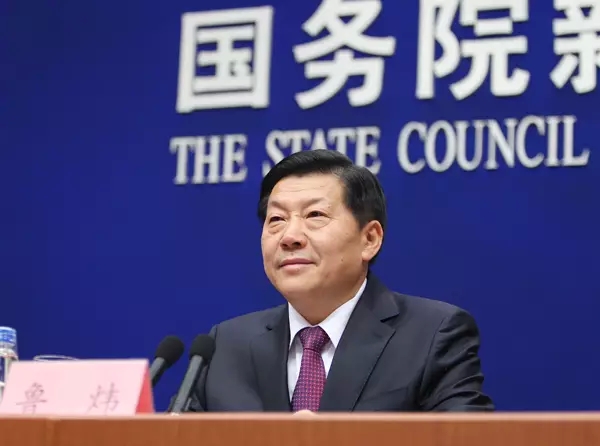
Lu Wei, minister of the Cyberspace Administration of China introduces the 2nd World Internet Conference at the press conference on Dec 9.
9:57 a.m.
Lu Wei:
This year’s meeting carries more features in comparison to last year's , such as:
1. Larger scale. It will have more than 2,000 participants from around the world, including 8 foreign leaders and close to 50 ministry-level officials, among them are Russia's Prime Minister Dmitry Medvedev, Pakistan's Prime Minister Nawaz Sharif, Kazakh Prime Minister Karim Massimov, Kyrgyz Prime Minister Temir Sariyev, and Tajik Prime Minister Kokhir Rasulzoda.
2. More representatives from more places. The participants come from more than 120 countries and regions, including the leaders of least 20 important global organizations, and more than 600 leading figures and experts from the Internet industry, specializing in different aspects of the Internet and cyberspace.
9:59 a.m.
Lu Wei:
3. More content. There will be 10 forums covering 22 subjects, including Internet cultural communication, innovative development of the Internet, digital economic cooperation, Internet technical standard, and cyberspace governance. During the “Light of Internet” Exhibitions, state-of-the-art developments and latest achievements in the Internet industry will be put on display.
4. The conference is smarter. As the permanent venue for the World Internet Conference, Wuzhen has become a city with positive environment, appealing culture, and improved access to Internet and intelligent services. With the support of Internet technology, Wuzhen has seen rapid development in online medical services, smart elderly care, government administration and makerspace. The conference is equipped with a tailor-made app, a cloud system, 4G Internet, fully coveraged Wi-Fi, and intelligent meeting services. With all the smart services, Wuzhen is ready to greet all friends.
The conference is co-hosted by the Cyberspace Administration of China and the government of Zhejiang province. For the first time, the United Nations Department of Economic and Social Affairs, International Telecommunication Union, World Intellectual Property Organization and World Economic Forum joined as co-organizers.
We have also set up a press center to help reporters to better cover the meeting and appreciate the charm of the ancient city of Wuzhen.
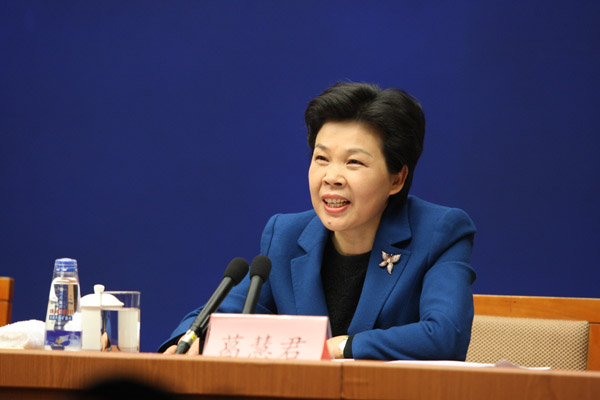
Ge Huijun, member of the Standing Committee of CPC Zhejiang Provincial Committee and director of the publicity department of the CPC Zhejiang Provincial Committee, speaks at the press conference of 2nd World Internet Conference on Dec 9. [Photo/China Daily]
10:08 a.m.
Ge Huijun:
Dear friends in the media, good morning. I am delighted to attend the press conference today.
The first World Internet Conference, held last year in Wuzhen, is still fresh in my memory. One year later, the beautiful town of Wuzhen in Zhejiang province is hosting the second World Internet Conference, and the annual "Wuzhen time" has arrived once again.
The World Internet Conference has permanently settled down in Wuzhen, reflecting the trust the central government has placed on us, and bringing great opportunities for the future of Zhejiang's development. The Conference has already brought about many changes to the province.
10:10 a.m.
Ge Huijun:
First, Wuzhen has experienced great changes. It is endowed with deep care and concern from President Xi Jinping, who visited Wuzhen for five times when he worked in Zhejiang, designing the development path for the ancient town.
Adhering to the development concept of the President, Wuzhen has taken off again while hosting the World Internet Conference.
Wuzhen has fully merged with the "Internet Plus" concept, with online medical services, smart tourism, and intelligent traffic successively put into operation. Its charm will further release with the all coveraged free Wi-Fi. Wuzhen is not only a historical town, a tourist town now, but also a smart town and a pioneering town for start-ups.
10:12 a.m.
Ge Huijun:
The second change is the economic structure. The World Internet Conference has now settled permanently in Wuzhen. The conference has advanced "Internet Plus" development in the province, and the Information-oriented economy has become a spotlight in its economic growth. Statistics show that last year, the index of the province's informationization reached 97.98, while the integrated index of industrialization and informationization reached 86.26, ranking the third highest in the nation. The information-oriented economy's added value was 228.8 billion ($35.75 billion) in the first nine months of 2015, taking up 7.7 percent in the province’s GDP. Emerging industries, such as e-commerce, Internet financing, Internet of Things, intelligent logistics, cloud computing and big data, and other Internet Plus industries, have all developed the own competitiveness over other provinces. The Internet has now truly become a new economic gene in Zhejiang province.
Thirdly, the summit is a growth engine. Zhejiang people are well known for their diligence and entrepreneurship, and local entrepreneurs always start their business from the scratch. The WIC will help Zhejiang attract global Internet talent and fuel local innovation and entrepreneurship.
Breaking ground and starting new businesses have become a phenomenon in Zhejiang. The Dream Village in Hangzhou has ushered in 4,100 experts with 380 startup projects since it was launched half a year ago. The Computing Conference, just convened under the witness of more than 40,000 attendees, offers a glimpse of the bright future of the information economy and the possibilities of the Internet Plus strategy.
10:17 a.m.
Reporters begin to ask questions
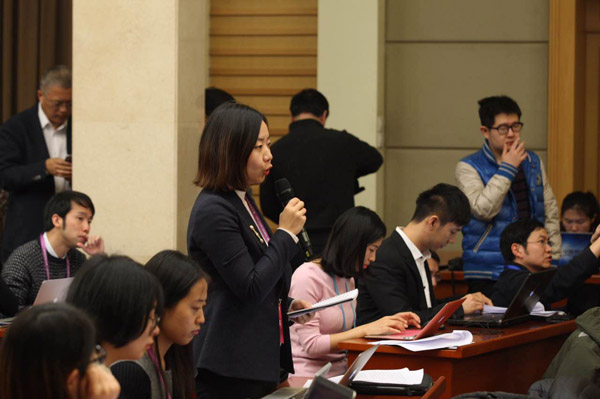
A journalist asks question at the press conference of 2nd World Internet Conference on Dec 9. [Photo/China Daily]
CCTV: The conference this year has the theme "An Interconnected World Shared and Governed by All -- Building a Community of Common Future in Cyberspace". Could you please explain a little bit about this theme?
10:18 a.m.
Lu Wei:
The theme of the 2nd World Internet Conference is "An Interconnected World Shared and Governed by All—Building a Community of Common Future in Cyberspace". Interconnectivity is the essence, which means the information is accessed at one point, and can be shared by the entire network. The Internet has turned the world into a "global village", and the cyberspace has become a new living space for mankind. The international society is becoming an interconnected community with a common future.
A peaceful, safe, stable and booming cyberspace is of great significance to the peaceful development of a country even the whole world. Nobody will remain immune from this space. Global sharing entails global governance. We have to deal with problems and challenges together.
China will assume the responsibility of a great network power. By holding the World Internet Conference, we hope to build a multilateral, democratic, transparent international Internet governance system that will better benefit the whole world.
10:21 a.m.
The Beijing News:
Mr Lu, what do you think about the foreign media's report that "the Chinese government has controlled the Internet firmly?" As Internet users, we sometimes find articles or posts on social media have been deleted, what's your opinion about this phenomenon?
10:23 a.m.
Lu Wei:
For the previous question, I've also noticed some reports from certain Western media. Some said China wants to control the Internet, which is just like nailing jelly to a wall.
The unknown part for the Internet far exceeds that of the known part. Some netizens said we even do not know much about the Internet yet, then we are entering the "Internet of Things" era; we do not fully understand cloud computing, then the fog computing appears. I'm afraid no country could boast it has brought the Internet totally under its control.
Since the 18th National Congress of the Communist Party of China, the Chinese Government has strengthened governance of problems over the Internet, especially online rumors, cyber-related crimes and cyber pornography. To protect the legal rights of the netizens, and a healthy environment for raising youth, we've achieved effective results and made cyber space cleaner.
However, we cannot overestimate our achievements. We are exploring an Internet management path with Chinese characteristics, which fundamentally means administrating the Internet through law. In other words, we should manage the relation between freedom and order. Just like the real world, cyber space is in no way beyond the law, and we need both freedom and order.
Like the morning rush on Chaonei Avenue in Beijing, all of us want to travel smoothly, that's why we need to stress the importance of order.
10:33 a.m.
Zhejiang Satellite TV:
What has changed in Wuzhen in the past years after the first World Internet Conference was held? What is the greatest benefit for Wuzhen as the permanent host of the conference?
10:34 a.m.
Lu Yuedong (Party chief of Tongxiang city, Zhejiang province):
Thanks for your question. WIC’s presence in Wuzhen is a great honor for Tongxiang, and we accept our responsibility to organize it.
More specifically, we will fulfill three duties:
First, we will try to make it a successful conference. WIC is on our priority list of government work. We will keep improving both facilities and services for the conference. We will strengthen the landscape planning of Wuzhen to keep its classic features as a Southern-China water town while at the same time making it more international and intelligent.
Second, to speed up economic growth, we will use the conference to promote the "Internet Plus" initiative and accelerate industrial upgrades by combining the Internet with industrialization, agricultural development, urbanization, and modernization in the service sector. Next, we will build our city into an Internet innovation pilot center. We will improve the Internet infrastructure and human resources, import new technologies and boost international cooperation. We aim to become a leader in cyberspace governing, turning Tongxiang from a traditional industrial city into an Internet-driven hub.
Third, benefiting our people.The Internet has really changed our thoughts and behavior, and also made traditional production much easier. We will attach great importance to the civil application of Internet technologies, and develop online smart services in healthcare, pensions, transportation, environmental protection, governance and other areas, which will benefit all people and raise their satisfaction. Thus, the Internet will become a leading force in making our people better-off.
Finally,on behalf of the hospitable Tongxiang residents, I would like to extend my warmest welcome to all guests from around the world. Welcome to Tongxiang and I hope you will appreciate the beauty of an ancient town with modern network civilization. And, Welcome to Wuzhen. Thanks!
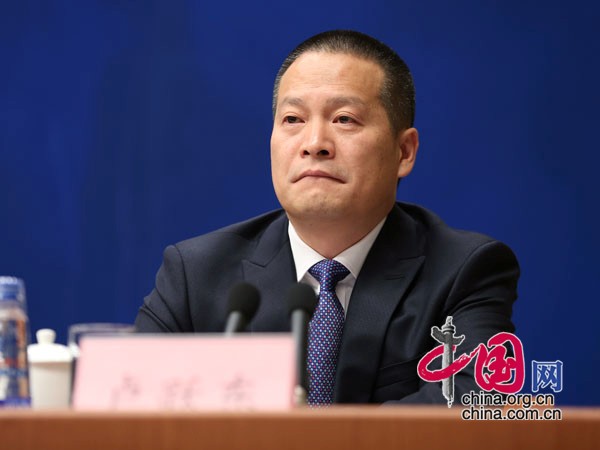
Lu Yuedong,the Party chief of Tongxiang city, Zhejiang province, anwsers a question at the press conference of 2nd World Internet Conference on Dec 9. [Photo/China.org.cn]
10:42 a.m.
CNN:
Speaking of the Internet's connectivity, I am wondering whether the increasingly strict Internet censorship in China will disconnect this country's cyberspace from the rest of the world in the age of information explosion and globalization? Now that the Chinese leadership calls for deepening reform, does Internet censorship contradict with the government's intention to show a confident and open China to the world?
10:52 a.m.
Lu Wei:
You mentioned three questions, the first one is on content review. China so far has 4 million websites, nearly 700 million netizens, 1.2 billion mobile phone users, and 600 million WeChat and microblog users; all these combine to produce 30 billion pieces of information every day. No country or organization has the capability to censor all this information. Thus, the expression "content review" is inadequate. But no "content review" doesn't mean no administration. In this area, China is learning from the developed countries, and we still have a lot to learn.
No country in the world conducts zero administration on the Internet, but management doesn't mean no freedom. As I said just now, freedom cannot be established on others' pain or by depriving others of freedom. If we did implement “content review”, how come the number of netizens keeps growing and their dependence on the Internet has been on the rise? However, certain bottom lines must be kept. Anyone who challenges the bottom line or breaks the law will be punished.
With regard to the second question about the local area network (LAN), I think I have talked about it last year here. I am not able to change your mind, but I have the right to choose a friend. I should make a choice whom I will invite home as a friend. Those who have made money in China but are bristling at Chinese people are not welcome. It is like a family which does not welcome unfriendly visitors.
On the third question, the so-called "block" and "proxy" whether or not it reflects that the Chinese government has stricter control on speech. What I want to say is that the government has strengthened the governance in cyberspace by law and opened up according to it. The door of opening-up will never close in China. Internet enterprises are welcomed to China as long as they do not hurt the national and consumer interest. Facts proved that Internet enterprises especially those from developed countries are growing continually in China, and some received about 50% of profit from the Chinese market. China is open and fair, and Internet enterprises around the world are confident in China.
11:09 a.m.
People's Daily Online:
What are the highlights of the Light of the Internet Expo?
11:10 a.m.
Ren Xianliang (Deputy minister of Cyberspace Administration of China):
The exhibition, featuring achievements of the country's Internet sector over the past 20 years and the world's latest technologies and applications, is co-hosted by the China Cyberspace Administration, Ministry of Industry and Information Technology, Ministry of Science and Technology and Zhejiang Provincial People's Government. It will highlight the concept of innovation, coordination, green, opening and sharing.
More than 260 companies from Europe, the United States, the Asia Pacific and Latin America will take part in the exhibition, where Baidu will debut its world-class self-driving car and Volvo will unveil the latest smart-connected car. Visitors will also see Nokia's latest Virtual Reality platform, China's 5G-network technology as well as the high-speed wireless Internet platform developed by the biggest mobile Internet company in the LA for the upcoming 2016 Rio Olympics.
What's more, small and medium-sized companies will showcase their innovative projects at the exhibition, while a museum themed at China's Internet sector will open for the first time. Dear journalists are more than welcome to visit the Wuzhen expo.
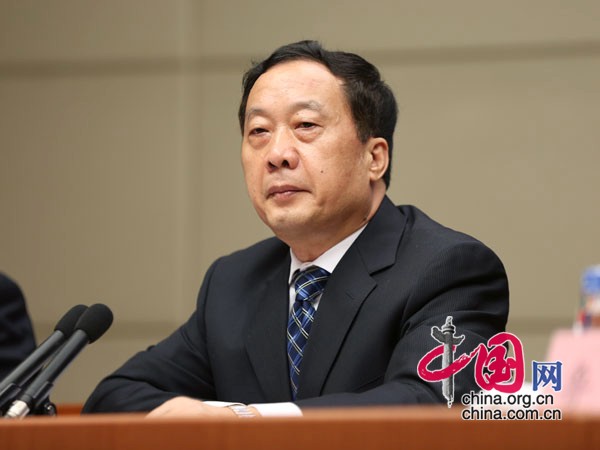
Ren Xianliang, deputy minister of Cyberspace Administration of China, anwsers a question at the press conference of 2nd World Internet Conference on Dec 9. [Photo/China.org.cn]
11:15 a.m.
Xinhua News Agency:
Ms Ge, what preparations has Zhejiang made for the conference this year since the first event last year? Apart from the features Mr Lu mentioned just now, are there others highlighted for the conference? Thanks.
11:16 a.m.
Ge Huijun:
First, Wuzhen has experienced great changes. It is endowed with deep care and concern from President Xi Jinping, who visited Wuzhen five times when he worked in Zhejiang, designing the development path for the ancient town.
Adhering to the development concept of the President, Wuzhen has taken off again while hosting the World Internet Conference.
Wuzhen has fully merged with the "Internet Plus" concept, with online medical services, smart tourism, and intelligent traffic successively put into operation. Its appeal will be further enhanced with the full coverage of free Wi-Fi inside the whole Wuzhen Scenic Area. Wuzhen is not only a historical town, and a tourist town, but also a smart town and a pioneering town for start-ups.
Second, smarter experience. Just now, Mr Lu described the smart experience in Wuzhen. We believe that ensuring information quality and security has an important role in the success of the WIC. And we have done work toward that end. The three major telecoms carriers – China Unicom, China Mobile and China Telecom – have built 502 base stations and 223 on-site spread systems for this year's conference and the Wuzhen Scenic Area's Internet band width is 220Gb/s and it is fully covered by Wi-Fi. The broad band is10Gb/s at meeting venues, 1Gb/s for desktops, and 100Mb/s for hotel rooms.There are also smart services, such as smart bikes, along with experiences, and applications in place. Reporters staying at the Gold Waterfront Hotel can rent a smart bike using a special card to get to the scenic spot anytime.
Third, more cultural characteristics. The WIC in Wuzhen is a combination of the traditional and the modern, which imparts a unique charm to the old town. We have also included some Zhejiang provincial characteristics this year. For instance, the reception party, "Night of Wuzhen", used the bridge as a symbol because Wuzhen has many bridges, 82 of them old stone bridges. And bridges imply connection, as does the Internet. Another example was the performance of "Butterfly Lovers", a classical Yueju Opera, China's second largest opera. This gave the audience the opportunity to enjoy Zhejiang's culture and arts.
11:26 a.m.
Bloomberg News:
The Chinese government announced its National Security Law recently which says that all "online technical products and services" will have a "national security examination and supervision". In the meantime, other related laws and regulations, including a cyber-security law and anti-terror law will be enacted. Does this mean that China will have more government censorship on the Internet? Some American enterprises think these rules are targeting them and they're concerned that they may be treated unfairly. What's your opinion on that?
11:27 a.m.
Lu Wei:
Your questions show the typical tones of foreign media. National Security Law of the People's Republic of China has been issued on July 1.The country's legislature also solicited public opinions about the drafts of the Network Security Law and the Anti-terrorism law. The laws not only safeguard the national interest of China, but also the legitimate rights of the foreign companies in China. The laws can be relied on to solve relevant issues.
Opening-up policy is our basic state policy and will not change as it has been proven throughout the decades-long reform and opening-up experiences. We would like to join hands with other countries to strengthen exchanges and communications, enhance cooperation to achieve win-win situations.
11:35 a.m.
China Radio International (CRI):
Mr Lu, you just mentioned that many participants at the conference are from countries and regions along the Belt and Road. What role can Internet play in promoting the Initiative?
11:36 a.m.
Lu Wei:
It is one of the significant features of this year's conference. The Belt and Road Initiative, proposed by China in 2013, received huge attention from the international community and active response from countries and regions along the Initiative, more than 40 of which will participate in the WIC. Interconnectivity of network and information is crucial for the Belt and Road Initiative. Open and inclusive, the Initiative enhances cooperation and win-win benefits for all. It's not a solo for one country, but a chorus for many countries and regions involved. By holding the World Internet Conference, we hope that the Internet will better benefit humankind and more countries would join us.
11:40 a.m.
Wen Wei Po:
Word came that a "Wuzhen Declaration" would be released as a consensus at this year's conference, and I want to confirm whether it is true.
11:41 a.m.
Lu Wei:
Some experts did come up with the idea of working out such a document during the preparation of the conference. The WIC was originally launched to let everyone in the industry to speak their minds. Public governance of the Internet needs consensus, but that can not be achieved with just one or two meetings. So it is not accurate that such a declaration will be released at this time. We will organize a group of experts to sort out the opinions and suggestions brought up by the guests at the WIC, and try to set international rules for cyberspace based on public intelligence and reach a consensus on cyberspace governing. This is a goal worth pursuing.
11:51 a.m.
Lu Wei:
Let us exchange thoughts, share common views, promote cooperation, and head for the future, so as to build a peaceful, safe and transparent cyberspace. Let the Internet development fruits benefit the people from China and the world. Let's meet at Wuzhen. Thank you very much.
11:52 a.m.
Guo Weimin:
That marks the end of today's press conference. Thank you.
