Quantum physics hot topic at forum
However, the strange behaviors of quantum particles were not fully explored in the development of classical computers or satellite navigation systems, which was the key difference from today's second revolution.
"We have now acquired the ability to isolate and manipulate single quantum systems and directly reveal their strange behavior," Haroche said. "We hope we will be able to harness this quantum strangeness in new devices with amazing possibilities to improve computing, communication and measurement."
One example is the quantum satellite. Haroche said the technology is based on the principle of quantum entanglement, an idea that posits that two quantum systems can still be somehow linked even if they are light-years apart, a phenomenon that Albert Einstein called "spooky action at a distance".
Detection of entangled photons provides a key for coding and decoding secret messages, and China has used it to develop the Micius satellite, launched in 2016.The satellite has successfully transmitted unbreakable information to ground stations 1,200 kilometers away, establishing a steppingstone for an ultra-secure communication network.
"Quantum information is a very promising field of research," Haroche said. "It illustrates the deep link between basic science, motivated by curiosity, and applied research aimed at developing innovative devices."
In a subforum with the theme "frontiers of science and disruptive technologies" on Friday, Norwegian neuroscientist Edvard Moser and his wife May-Britt Moser, who both received the Nobel Prize in physiology or medicine 2014, introduced their findings on cells that constitute a positioning system in the brain. They were followed by Takeo Kanade, a Japanese computer scientist and one of the world's foremost researchers in computer vision, who presented his studies in autonomous driving.
Such disruptive technologies are arguably at the frontiers of science, but they are also the subject of public concerns over potentially disruptive effects on society, such as the safety of self-driving vehicles, as well as ethical issues about whether advances in neuroscience could lead to mind reading or manipulation, said Poo Mu-ming, a Chinese-American neuroscientist who is also an academician of the Chinese Academy of Sciences.
Calling himself a firm believer in the potential for AI to be smarter than humans, Kanade said people will never be able to outsmart machines in some facets, such as the amount and speed of calculations, but the application of AI will still take a long time.
"Don't forget, human beings are the creators of AI," he said. "So human beings are responsible for putting AI in good service and letting it play a good role."
May-Britt Moser said: "Scientific research is a process where we discover solutions, and it is up to humans ourselves to decide whether to apply them. If we don't study neuroscience, more people, including more children, may lose their lives due to diseases. If we don't do research on autonomous driving, more people may be killed in traffic accidents.
"These too are ethical issues. It is not easy for us to find an absolute balance."
 In pics: Lin-gang Special Area's magnificent bridges
 Video: Stunning aerial scenery in Lin-gang Special Area
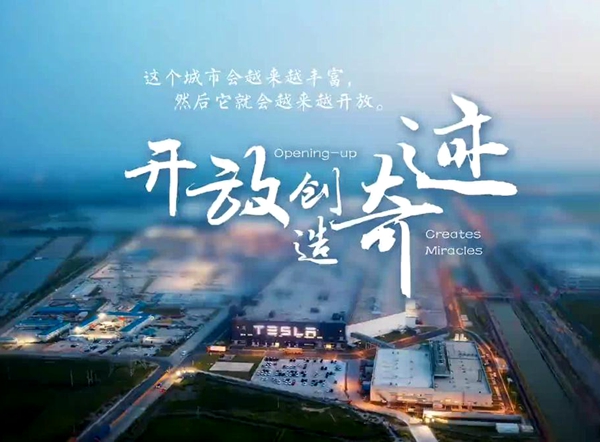 Video: Opening-up creates miracles
-
Address No 200 Shengang Avenue, Pudong New Area, Shanghai, China
-
Zip Code 201306
-
TEL +86-21-68283063
-
FAX +86-21-68283000