Lin-gang Satellite Research and Manufacturing Base goes into operation
The northern area of Lin-gang Satellite Research and Manufacturing Base launched its operations on Oct 12. The base was developed by the Innovation Academy for Microsatellites of the Chinese Academy of Sciences (CAS), which successfully launched the quantum communication satellite, Mozi, the dark matter detection satellite, Wukong, and the Beidou navigation satellite.
At the same time, the Innovation Academy for Microsatellites started construction of the Shanghai Science and Technology Innovation Center Collaborative Innovation Cross Research Platform – Microsatellite Modular Intelligent Manufacturing and Application Innovation Platform project in the southern part of the Lin-gang manufacturing base.
In December 2019, agreements for the first group of key projects in Lin-gang Special Area of China (Shanghai) Pilot Free Trade Zone were signed and construction started, including 23 projects with total investment of more than 11 billion yuan ($1.58 billion). The project of the Innovation Academy for Microsatellites was one of the deals signed that day.
The overall plan for the base covers about 160,000 square meters, with total investment of about 2.2 billion yuan. The project will be constructed in four phases.
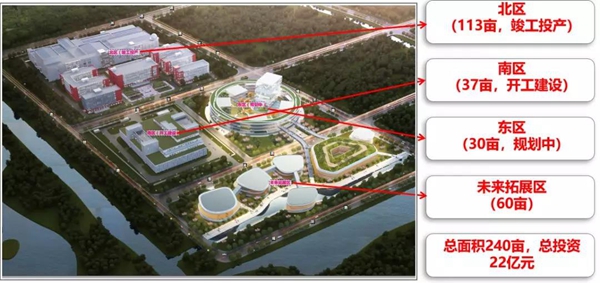
A planning map of the Lin-gang Satellite Research and Manufacturing Base [Photo/WeChat account: shlgguanweihui]
The first phase, the northern area, has a satellite assembly plant covering 36,000 sq m, seven satellite assembly halls, and perfect test conditions. The northern area will mainly undertake the production of communication, navigation and remote sensing equipment.
The construction of the second phase, the southern area of the project, is expected to be completed and put into operation by the end of 2021. The southern area will have a satellite innovation factory, five platforms for satellite development, including full satellite process planning management and a cloud data support platform, to facilitate the production of more than 600 commercial micro and nano satellites in the next decade.
The third phase, the eastern area, will cover two hectares, and will focus mainly on building a space industry incubator and space academic exchange center. Relying on the technical strength of the satellite innovation academy, the eastern area will focus on the incubation of the aerospace industry, aiming at the development and application of remote sensing data, satellite communication applications, navigation and positioning applications, and the development of a creative aerospace industry.
The fourth phase will cover four hectares, with total investment of about 600 million yuan, and will focus on the development of the satellite manufacturing and application industry, chip development and manufacturing, high-performance components and single machine development for satellites, and mass development of low-cost ground application equipment.
The planning and construction of Lin-gang Satellite Research and Manufacturing Base will play an important role in meeting the major strategic needs of the State, helping the construction of the National Science Center and Shanghai Science and Technology Innovation Center, improving the comprehensive innovation capacity of aerospace technology, and focusing on major strategic emerging industries.
Zhou Sigen, deputy secretary of the CPC committee of the academy, said that it is expected that in the next decade, the academy will make hundreds of satellites in Lin-gang with economic benefits reaching to tens of billions of yuan.
"In the process of project approval, we have fully enjoyed the high-quality service of Lin-gang Special Area, and were impressed by the working speed and efficiency of the special area," Zhou said.
 In pics: Lin-gang Special Area's magnificent bridges
 Video: Stunning aerial scenery in Lin-gang Special Area
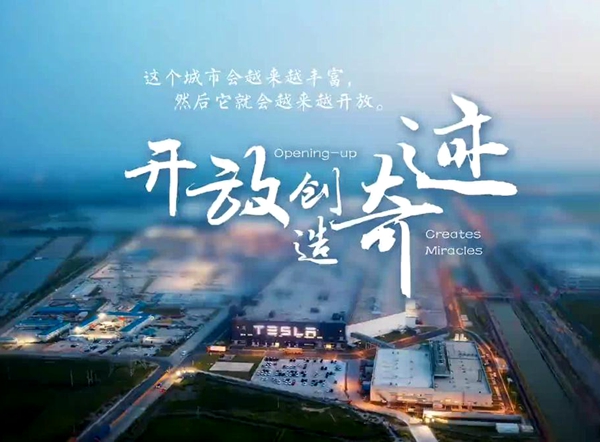 Video: Opening-up creates miracles
-
Address No 200 Shengang Avenue, Pudong New Area, Shanghai, China
-
Zip Code 201306
-
TEL +86-21-68283063
-
FAX +86-21-68283000