Nuclear medicine specialists make history in Barbados
Updated: 2018-09-20
Barbados' first case of SPECT/CT radionuclide imaging after a ventriculo-peritoneal shunt for hydrocephalus was a recent success at the country's Queen Elizabeth Hospital (QEH).
Cheng Gang, head of the second Chinese medical team to Barbados and an associate professor of nuclear medicine, conducted the operation in cooperation with Dr. Gill, director of surgery at QEH surgery.
"I have never met the situation in the past 20 years," Cheng said. He said that the 80-year-old patient had a ventriculo-peritoneal shunt due to communicating hydrocephalus several years ago. After referring to relevant literature and making preparations, Cheng decided to carry out the first cerebrospinal fluid shunt imaging with Dr Gill at QEH.
On Jan 12, 2018, Cheng determined that 99mTc-DTPA would be the imaging agent, the dose and the imaging process, and other matters after referring to relevant documents and reports. Through injecting the imaging agent into the ventricle under an aseptic state, the team successfully completed the first cerebrospinal fluid shunt SPECT/CT radionuclide imaging.
As a nuclear medicine expert, Cheng has carried out about 150 cases of various types of radionuclide imaging at QEH in half a year (many of which implemented new technologies that QEH has never developed), including the first renal radionuclide imaging, the first reflex sympathetic dystrophy radionuclide imaging, and the first bone SPECT/CT image fusion. Ian, director of QEH radiotherapy, praised Cheng for making history in the development of QEH nuclear medicine.
Due to Cheng's outstanding performance, Dr. Harris, the deputy executive director of QEH, said he hoped there would be nuclear medicine experts as well on the third medical team.
The Chinese medical team has not only made history, but also deepened the friendship between the people of China and Barbados.
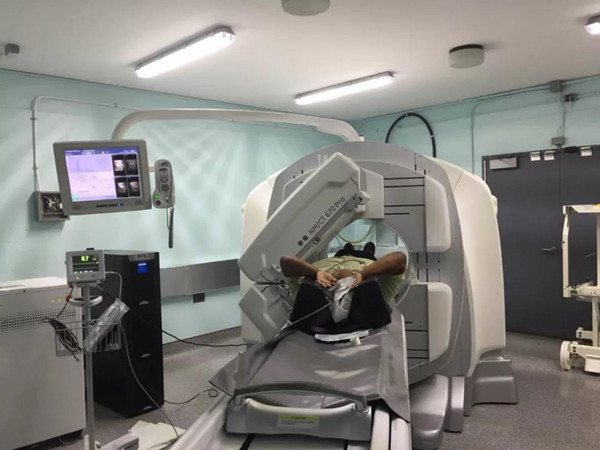
Barbados' first case of SPECT/CT radionuclide imaging after a ventriculo-peritoneal shunt for hydrocephalus is conducted at the Queen Elizabeth Hospital. [Photo/WeChat account of zgzbbdsyld]