Acting as a magnet for talent
Zhongguancun science park's London office works to persuade Chinese graduates to start companies in the Beijing high-tech zone
Foreign tourists visiting China in the early 1980s may have been familiar with Beijing's Zhongguancun district as an immense market for electrical devices and components, but today's Zhongguancun has been transformed into a hub of innovation and home to many of China's tech giants.
Zhongguancun, renamed the Beijing High-Technology Industry Development Experimental Zone in 1988, spans 483 square kilometers, hosts 25,000 technology companies and is known as China's Silicon Valley. In 2016, the district accounted for 25 percent of Beijing's GDP and 39 percent of the municipality's economic growth.
|
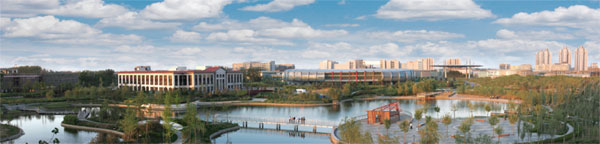
Zhongguancun Science Park in Beijing is built to provide the best service to help connect talent and projects in Britain and the resources in China to realize win-win collaboration. Photos Provided to China Daily |
It is home to 312 listed companies with a total market value of more than 5.5 trillion yuan ($840 billion). Some of its high-tech enterprises have grown from startups to China's leading companies, such as the search engine Baidu and computer maker Lenovo.
The district, officially known since 1999 as Zhongguancun Science& Technology Zone, has also established 10 overseas liaison offices that work to persuade Chinese graduates to start companies in Zhongguancun rather than in their host nation, and in the process bring overseas technology and expertise back to China.
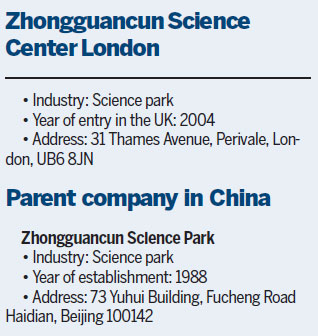
Zhongguancun's London office was established in 2004 in Perivale, close to routes to Oxford and Cambridge. Over the years, the Zhongguancun UK team has focused on persuading British-educated scholars and researchers to take their expertise to Zhongguancun Science Park in Beijing and start companies there.
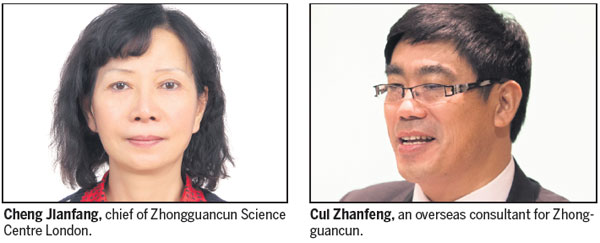
Cheng Jianfang, chief of the Zhongguancun Science Centre London, says China and the UK's technology and innovation sectors complement each other. "In particular, the UK has abundant cutting-edge technology created from its leading universities, and China has the market and commercialization capability to help those technologies grow," she says.

"We want to provide the best service to help connect talent and projects in Britain and the resources at Zhongguancun Science Park to realize win-win collaboration," Cheng adds.
Zhongguancun Science Park is attractive for UK-educated scholars who return to China because it is in an advantageous position with the Chinese government, which can help with settling visa and funding issues.
Entrepreneurs who do not hold Chinese passports can generally receive longer-term visas if they work in Zhongguancun. Without such support, they would need to renew their China working visa more frequently.
Zhongguancun also grants funding to overseas-educated Chinese entrepreneurs who choose to start their companies in Zhongguancun, provided that their company ideas fit into the overall Zhongguancun strategy.
In addition, Zhongguancun can also provide rent discounts to startup companies in the early stages of development. Also attractive is its proximity to many leading universities in Beijing, which can help the companies recruit top talent.
"Zhongguancun's provision of policy support, finance for developing product prototypes and land to build factory space are all attractive for overseas-educated talent who wish to set up their companies in China," says Cui Zhanfeng, an overseas consultant for Zhongguancun.
Cui, who is also a professor at the University of Oxford's Department of Engineering, adds that the entrepreneurship opportunities provided by Zhongguancun also help overseas scholars realize their dream of using their scientific research results to benefit more people, due to China's large market and population.
The area of Zhongguancun in Beijing existed long before it officially became a government-recognized high-tech zone. With China's reform and opening-up in 1978, an increasing number of private-sector technology companies emerged, and many of these companies gathered in the area of Zhongguancun due to its location in Beijing and proximity to many top universities.
Over the next decade, these high-tech companies grew quickly and caught the attention of the central government. In 1988, the central government officially turned the Zhongguancun area into a government-supported science park, which was the starting point for Zhongguancun-based companies to enjoy preferable visa policies for their employees and to receive government grants and funding for their development.
With visa and funding support, Zhonggguancun's growth took off. As more high-tech companies gathered there, Zhongguancun increasingly became attractive to new companies attracted to the area's innovation ecosystem, which is very important to technology companies that need frequent communication and idea-sharing with supply chain companies that are also tech companies.
Meanwhile, the young, highly qualified and largely overseas-educated workforce at Zhongguancun also became attractive for more like-minded overseas-educated Chinese students coming back to China to work. So far, more than 15,000 highly qualified returnees are working in Zhongguancun, many of whom have completed their PhD studies in overseas institutions, including in Britain.
One such British-educated talent is Ruan Anbang, founder and CEO of OCTA Innovation, an information security company. While working for his PhD at Oxford, Ruan participated in a trip to visit Zhongguancun along with a dozen other students selected by the Zhongguancun London office in 2014. That trip increased his desire to return to China to start his own business.
"During the three-day visit to Zhongguancun, we visited the managers of the various science parks within Zhongguancun to learn about their policies and support," Ruan says. "We also met with businesses that already have become successful in Zhongguancun. I felt excited to go to Zhongguancun and start my business."
In 2016, Ruan established his business in Zhongguancun along with a former classmate. The company started in a small office space in the science park, with favorable rent. By the end of that year the business had received 10 million yuan in angel investment from Hong Tai Fund, which allowed the business to quickly scale up.
Lai Zhaohong, CEO of Beijing TopCom Technology, which specializes in big data technology, is another such overseas-educated talent who started his company in Zhongguancun.
Lai says that when he was returning to China to establish his business, he was considering locations in Beijing, Shanghai and Guangzhou, but what attracted him to Zhongguancun in 2013 was the concentration of talent.
"Zhongguancun is China's Silicon Valley. As a high-tech company, we need to work with many other supply chain companies, so locating our company in Zhongguancun gives us efficiency for collaboration."
When Lai established Beijing TopCom Technology, the company was given a 50 percent discount on its rent in its initial growth stage. In addition, it received 100,000 yuan in funding, which Zhongguancun grants to entrepreneurs who return to China to establish their businesses after finishing their overseas education.
"Zhongguancun gives good support to entrepreneurs, and the Zhongguancun London office plays a significant role in connecting overseas talent with the opportunities in China, because it understands overseas talent's skills and strengths and is familiar with the details of China," says Lai.
More recently, Cheng's team also started the process of looking at the possibility of finding a suitable location in the UK to host an accelerator for startups before introducing them to Zhongguancun Science Park.
The UK accelerator follows the same model that Zhongguancun created when it established a similar incubator inside Silicon Valley in the United States in 2015. With 7,000 square meters of office space, the accelerator already hosts some US-based startups.
"Our accelerator will focus on helping technology startups founded in the UK and which also have an ambition of growing further in China to get off the ground. After they grow to a certain size, we can also help them to scale up in Zhongguancun Science Park," Cheng says.
Zhongguancun Science Park is also becoming increasingly global. It is home to the China headquarters and research centers of Western tech companies such as Google, Intel, Oracle, Sony and Ericsson. By the end of 2016, Zhongguancun's companies had established 535 branches overseas.
cecily.liu@mail.chinadailyuk.com
(China Daily European Weekly 01/19/2018 page30)